
So, after all, that, let us return to Plait’s argument. He tells us that the problem is too many people perceiving evolution as a threat to their religious beliefs. Indeed, but why do they perceive it that way? Is it a failure of messaging on the part of scientists? Is it because Richard Dawkins or P. Z. Myers make snide remarks about religion? No, those are not the reasons.I hope Phil Plait is listening.
It is because these people have noticed all the same problems the scholars of Darwin’s time were writing about. It is because evolution really does conflict with their religious beliefs, but not because of an overly idiosyncratic interpretation of one part of the Bible. It is because the version of evolution that so worried the religious scholars of Darwin’s time, that of a savage, non-teleological process that produced humanity only as an afterthought, is precisely the version that has triumphed among modern scientists. And it is because the objections raised to that version of evolution in the nineteenth century have not lost any of their force today.
So I think the issue is just a tad more complex than Plait suggests. It manifestly is not the case that only the most narrow of fundamentalists has a problem with evolution. Evolution challenges the Bible, refutes the argument from design, exacerbates the problem of evil, and strongly challenges any notion that humanity plays a central role in creation. These are not small points, and Plait needs to acknowledge them.

I can’t stress this enough. The conflict over the teaching of evolution is based on the false assumption that evolution is antagonistic to religion. This is why, I think, evolution is so vehemently opposed by so many in the United States. The attacks on the specifics of evolution—the claims about irreducibility of the eye, for example, or other such incorrect statements—are a symptom, not a cause. I can talk about how we know the Universe is old until the Universe is substantially older and not convince someone whose heels are dug in. But if we can show them that the idea of evolution is not contrary to their faith, then we will make far, far more progress.This is the classic accommodationist position. Problem is, it's been tried and it doesn't work in the United States. And the reason it doesn't work is that Americans aren't that stupid. They realize that these debates really are about science vs. religion. They know that evolution is, in fact, antagonistic to religion.
That’s not to say I’ll stop talking about the science itself. That still needs to be discussed! But simply saying science is right and faith is wrong will never, ever fix the problem.
And this won’t be easy. As long as this discussion is framed as “science versus religion” there will never be a resolution. A religious person who doesn’t necessarily think the Bible is literal, but who is a very faithful Christian, will more likely be sympathetic to the Ken Hams than the Bill Nyes, as long as science is cast as an atheistic dogma. For example, on the Catholic Online website, the argument is made that both Ham and Nye are wrong, and casts science as an atheistic venture.
That must change for progress to be made.
And who should do this? The answer to me is clear: Religious people who understand the reality of science. They have a huge advantage over someone who is not a believer. Because atheism is so reviled in America, someone with faith will have a much more sympathetic soapbox from which to speak to those who are more rigid in their beliefs.It's possible that "religious people who understand the reality of science" is a very small group and it's even more possible that they will be opposed to science and evolution precisely because they DO understand the reality of science. Plait is probably thinking about Ken Miller and Francis Collins but it's not clear to me that they truly understand what science is telling us. Science is telling us that there's no need for god(s) in order to understand the world around us. Evolution tells us that life has no purpose.
[Ruse] fails to grasp the real nature of the conflict. It's not just about evolution versus creationism. To scientists like Dawkins and Wilson, the real war is between rationalism and superstition. [my emphasis, LAM] Science is but one form of rationalism, while religion is the most common form of superstition. Creationism is just a symptom of what they see as the greater enemy: religion. While religion can exist without creationism, creationism cannot exist without religion.This passage has been widely quoted and I wholeheartedly agree with Coyne's view.1
1. There's some doubt about whether Coyne actually said this in his letter. I'm quoting a second-hand source: Dawkins in The God Delusion.
2. I'm not saying we are correct. I'm just saying that after all these years it's disappointing to see so many accommodationists who just don't get it.

CLICK HERE TO REGISTER
At the first event of the series, Fr. Philip Cleevely (Catholic priest and philosophy professor) and Justin Trottier (founder of the Centre for Inquiry Canada) will argue the question, "Is There a God?" The debate will be moderated by Stephen LeDrew (host/commentator of CP24).
Date: Friday, February 7 from 7:00-9:30pm
Venue: Isabel Bader Theatre (Victoria University)
93 Charles Street West, Toronto
Registration: Limited seating. Tickets cost $10. Click here to register.
Biographies:
Fr. Philip Cleevely, C.O. was born in England in 1966. Educated in English Literature and Philosophy at Oxford and Cambridge Universities (UK) and in Toronto, he joined the Catholic Church in 1989. For years later, he entered a religious community in Birmingham, England called the Oratory of St. Philip Neri. Following theological studies in Rome, he was ordained to the priesthood in 2001. At the beginning of 2011, he transferred permanently to the Oratory community in Toronto, where he teaches Philosophy and Theology at St Philip’s Seminary.
Justin Trottier is Founder and Ambassador for the Centre for Inquiry Canada, an educational charitable organization advancing science and secularism. He is a board member of the Canadian Secular Alliance and a regular spokesperson on church-state separation, skeptical inquiry and fundamental freedoms. He hosts Think Again! TV, appears regularly on the John Oakley Show’s Culture War on AM640 Toronto radio and the Conspiracy Show on Vision TV, and publishes on the National Post’s religion blog. He ran as a candidate in the 2011 Ontario provincial election. With a passion for science education, Justin also hosts The Star Spot, a space sciences themed podcast and radio show
After-party:
After the event, all of our atheist, freethinking, and skeptical members, guests and friends are invited to join us at:Keep the discussion going on our Facebook Page.Gabby’s Bar & Grill
192 Bloor Street West
Toronto
ON M5S 1T8

Evolution Weekend is an opportunity for serious discussion and reflection on the relationship between religion and science. An ongoing goal has been to elevate the quality of the discussion on this critical topic, and to show that religion and science are not adversaries. Rather, they look at the natural world from quite different perspectives and ask, and answer, different questions.Maybe it's just me, but I thought that "serious discussion and reflection" means that all aspects of the conflict between science and religion would be considered. This includes the possibility that the conflict is very real and cannot be accommodated.
Because religion and science use different methodologies to understand the world, and because religion and science ask very different questions, there is no reason to view them in conflict. One important facet of Evolution Weekend 2014, therefore, is to explore the questions each ask and to examine the different ways of knowing embodied in each.There's not going to be any serious discussion about different ways of knowing and which ones are successful.
[Hat Tip: Panda's Thumb]

So what do ID proponents believe?This is a very broad definition. If you believe in God then you pretty much have to be an IDiot unless you are a strict deist. Every single religious person that I know believes that "there must have been more than unintelligent forces at work somewhere, somehow, in the whole process."1 Therefore, every Roman Catholic and every evangelical Christian is an IDiot, according to Granville Sewell. This includes Ken Miller and Francis Collins. In fact, it includes every religious scientist.
Perhaps the best way to answer this question is to state clearly what you have to believe to not believe in intelligent design. Peter Urone, in his 2001 physics text "College Physics" writes, "One of the most remarkable simplifications in physics is that only four distinct forces account for all known phenomena."
The prevailing view in science today is that physics explains all of chemistry, chemistry explains all of biology, and biology completely explains the human mind; thus physics alone explains the human mind and all it does. This is what you have to believe to not believe in intelligent design, that the origin and evolution of life, and the evolution of human consciousness and intelligence, are due entirely to a few unintelligent forces of physics.
Thus you must believe that a few unintelligent forces of physics alone could have rearranged the fundamental particles of physics into computers and science texts and jet airplanes.
Contrary to popular belief, to be an ID proponent you do not have to believe that all species were created simultaneously a few thousand years ago, or that humans are unrelated to earlier primates, or that natural selection cannot cause bacteria to develop a resistance to antibiotics.
If you believe that a few fundamental, unintelligent forces of physics alone could have rearranged the basic particles of physics into Apple iPhones, you are probably not an ID proponent, even if you believe in God. But if you believe there must have been more than unintelligent forces at work somewhere, somehow, in the whole process: congratulations, you are one of us after all!
1. Yes, I know about atheist Buddhists. That doesn't count as a "religion" in my book.
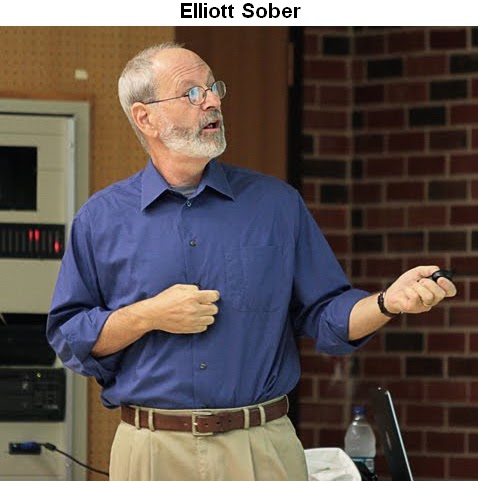
Theism = God existsThe lecture is about something called "evidentialism." Elliott Sober claims that the following proposition is true ...
Atheism = God does not exist
Agnosticism = We don't know whether God exists
For any proposition, you should believe it only if you have evidence that it is true and you should disbelieve it only if you have evidence that it is false.He then goes on to show that we can never have evidence that God does not exist. Therefore, "If 'God exists' is untestable, you ought not to be an atheist. You should be an agnostic."
1. I am not suggesting that Sober's definition is wrong. He should not be ignoring the fact that many members of his audience don't agree with his definition and that's why they are atheists.


… I wanted to wish everyone a really really Merry Christmas, Happy Hannukah, all the holiday… all you infidel atheists out there, I want to wish you the very best, also. I don’t know what you celebrate during the holiday season — I myself celebrate the birth of Christ — but it’s your choice, and I respect your choice. If you wish to celebrate nothing and just get together with friends, that’s good, too. All the best.
 )
)[Hat Tip: Friendly Atheist]


Montreal, 17th September 2013 — Atheist Freethinkers (LPA-AFT), an association which promotes secularism and supports the rights of atheists, welcomes the intention of the government of Quebec to adopt a so-called Charter of Values which would formally establish the secular status of the Quebec state. The project is outlined on its website www.nosvaleurs.gouv.qc.ca.
The proposed Charter would formally declare separation of religion and state, the religious neutrality of the state and the secular nature of its institutions. It would impose an ethics of restraint and religious neutrality for public servants. It would prohibit obvious religious symbols in the public service. And it would establish clear guidelines for so-called “reasonable” accommodations. Furthermore, it would make it mandatory for any client of public services to have one’s face uncovered in order to be served. All of these measures go in the direction of formalizing the secular nature of the state and assuring the independence and autonomy of the state from religion. This is very good news.
However, like most who support the proposed Charter, we do so with some reservations. Firstly, the title “Quebec Charter of Values” is very badly chosen. What Quebec requires is a Charter of Secularism, a charter which expresses values which have universal, human import, the values of the Enlightenment.
Secondly, it has not been proposed that the large crucifix be removed from the wall of the Quebec National Assembly in Quebec City. This object was installed there in 1936 by the Duplessis government of the day, with the aim of consecrating its alliance with the Catholic Church. If the crucifix is a “Quebec value,” it represents the worst possible value in this context. Its presence in the most important venue of the Quebec state is a blatant violation of secularism, a glaring symbol of non-secularism! The Charter should stipulate its removal – to a museum for instance. To leave it in place would be totally inconsistent and expose the authors of the Charter to charges of hypocrisy. However, it is important to realize that keeping the crucifix in the National Assembly is not explicitly stipulated in the proposed Charter. In fact, this crucifix is not even mentioned there.
Thirdly, the proposed ban on state employees wearing religious symbols while on duty has been poorly formulated. The plan is to include an official dress code in the Charter of Rights and Freedoms. However, this Charter is a quasi-constitutional document and should stipulate only the principle that public servants must exercise restraint – so that public services remains neutral with respect to religion – and establish a mechanism for the implementation of this principle. The dress code and other aspects of the behaviour of public servants belong to the implementation of this principle and should not be included in the Charter of Rights and Freedoms itself. In that way, the details and timing of the implementation would remain open to democratic debate.
The draft Charter was released barely a week ago and we continue to study it. Other aspects of the project may require critical analysis. Moreover, a completely secular charter would include several provisions not included in the announced project – such as cutting public funding to private religious schools; banning prayer at municipal council meetings; banning prayer rooms in government buildings; ending religious accommodations granted for ritual slaughter of animals; prohibiting mutilation of the human body without valid medical reasons and without the consent of the adult concerned; withdrawal of the Ethics and Religious Culture program from public schools; and removal of tax incentives to religious institutions and members of religious orders. These omissions remain to be addressed.
The organization Atheist Freethinkers commends the government for its courage. We note that the government is not responsible for the inflammatory and demagogic excesses of the exaggerated political opposition that arose against its attempt at secularization, even if such excesses could have easily been predicted. This project is not an exercise in identity politics. The numerous accusations of intolerance, xenophobia and even racism are extremely dishonest and even defamatory. Nevertheless, the government could have prevented the worst and minimized the damage by avoiding any measure which the opposition might use as an excuse. Excluding religious symbols is necessary in order to ensure not only the religious neutrality of the public service but also the perception of neutrality. By the same token, the government must not only avoid identity politics but also the perception of such politics. If the proposed Charter had specified the removal of the crucifix from the National Assembly, if its authors had chosen a title with more universal scope, if the plan for gradual removal of religious symbols had been better presented, then the intellectual vacuity of the opposition would have been obvious and that opposition would have been greatly defused.
Despite our reservations, we support the proposed Charter. It could serve as a model for other Canadian provinces and jurisdictions, each adapting the Charter appropriately and provided of course that the model is improved upon – in particular by avoiding the failings discussed above.
As atheists, we greatly value freedom of religion because atheists and apostates are often among the first victims when that freedom is violated. We know that freedom of religion is incomplete or even hollow if it does not include freedom from religion. Thus secularism is important not only for us as atheists but also for believers: it is essential that public institutions, i.e. state institutions, be independent of any religion and, at the same time, that total freedom to practice the religion of one’s choice, or to practice none, be protected in the private sphere and in the public sphere outside of such institutions.

 The results of the 2011 Canadian census are beginning to appear. Indi at Canadian Atheist has prepared a nifty pie chart showing that 63.7% of the population identifies themselves as Christians [2011 National Household Survey religion results].
 22. What is this person’s religion?I think you can see why nonbelievers may be somewhat higher than the numbers indicate.
Indicate a specific denomination or religion even if this person is
not currently a practising member of that group.
For example, Roman Catholic, Ukrainian Catholic, United Church,
Anglican, Lutheran, Baptist, Greek Orthodox, Jewish, Islam, Buddhist,
Hindu, Sikh, etc.
Specify one denomination or religion only __________
No religion __________
six days and counting till the World Premiere of The Unbelievers at Hotdocs International Film Festival in Toronto. An extra screening of the film just added. Stay tuned after that for announcements.We're going on May 1st. Why not join us?

 Imagine a typical1 citizen of a country in Western Europe. She doesn't believe in god(s) and neither did her parents or grandparents. How should she feel? Should she be depressed and overcome with a sense of hopelessness because there are no god(s) to save her?
 Last Sunday (March 3, 2013) CBC radio aired a discussion on "Does religion have a place in public life?" The host was Rex Murphy. You can listen to the entire thing at: Does religion have a place in public life?.
... you're debating the wrong question. It's not the role of religion in public institutions. it's the difficulty of being a person of faith working with people who haven't any ... any religion. And I'm speaking as someone with 27 years in parliament ...It gets worse. She claims that atheists simply don't share her values, such as the Golden Rule, therefore you can't find common ground when trying to make policy.
[Hat Tip: Thanks to Tony Burns for preparing the audio excerpt.]


.JPG)

.jpg)


dbl.jpg)


