Wednesday, December 4, 2013

Cherry picking and the safety of low level electromagnetic radiation

While I was researching the previous article on the safety of GM foods, I came across the website of Magda Havas. Here's how she describes herself ...
Magda Havas is Associate Professor of Environmental & Resource Studies at Trent University where she teaches and does research on the biological effects of environmental contaminants. Dr. Havas received her Ph.D. from the University of Toronto, completed Post-Doctoral research at Cornell University, and taught at the University of Toronto before going to Trent University in Peterborough, Canada.

...

Dr. Havas’s research since the 1990s is concerned with the biological effects of electromagnetic pollution including radio frequency radiation, electromagnetic fields, dirty electricity, and ground current. She works with diabetics as well as with individuals who have multiple sclerosis, tinnitus, chronic fatigue, fibromyalgia and those who are electrically hypersensitive. She also conducts research on sick building syndrome as it relates to power quality in schools.

Since the mid 1990s Dr. Havas has taught about electromagnetic pollution in several courses at Trent University and has supervised Reading Courses and Honours Thesis Projects in this area. One of the courses deals specifically with the biological effects of electromagnetic fields and electromagnetic radiation. This is one of the few courses available in North America at a senior undergraduate level critically examining the effects of non-ionizing radiation.
Here comes the fun part. She has made a video in which she explains why we need to pay attention to all the scientific studies showing harmful effects of power lines, cell phones, WiFi etc. She uses Popper's criterion of falsifiability to justify her rejection of all articles that show no harmful effect and she turns cherry-picking completely upside down to support .... cherry-picking!

Don't you just love the title of this video?


In case you don't get it, here's a bit of extra reading.
Magda Havas’ New EHS Study Has Serious Flaws
Trust Me, I’m A Doctor: Magda Havas And WiFi


Is there any reliable scientific evidence that genetically modified food poses a health risk?

I recently had a discussion about the safety of food derived from genetically modified organisms. My opponent, whose identity I will conceal (hi Rachel!), argued that GM foods are unsafe and that there's scientific evidence to back this up. Naturally, this evidence is being concealed by Monsanto and other private companies in the same way that tobacco companies tried to hide the evidence that smoking causes lung cancer.

My position is that I'm not aware of any reliable scientific studies showing that GM foods are dangerous to your health and, furthermore, in a free and open democracy with a free press it seems highly unlikely that such evidence is being suppressed. It seems even more unlikely that scientists would be part of this conspiracy.

Read more »

Cara Delevingne - Vogue UK - January 2014

Photography: Alasdair McLellan
Stylist: Kate Phelan
Hair: Anthony Turner
Makeup: Lisa Butler

Michael Eisen defends 23andMe against the FDA

The US Food and Drug Administration has asked 23andMe to stop marketing their genetic test product. The company will test your DNA for the presence of several genetic markers that might indicate a predisposition to disease. The FDA is concerned that 23andMe is not doing enough to ensure that its tests are accurate and the advice it gives is medically sound.

Michael Eisen is on the Scientific Advisory Board for 23andme. He responds to the controversy: FDA vs. 23andMe: How do we want genetic testing to be regulated?.

I think some of his points are worth discussing. My position is that the links between certain diseases and certain SNPs are not well-established. The scientific literature on this topic is not all that great and many of the published results have not been repeated. What this means is that private companies like 23andMe are under pressure to be the first to include a new link in their database but may not be exercising the appropriate amount of skepticism.

Read more »

Tuesday, December 3, 2013

How do creationists interpret Lenski's long-term evolution experiment?

Lenski's long-term evolution experiment has resulted in dozens of publications in high quality journals. It has led to significant insights into evolutionary processes [e.g. Lenski's long-term evolution experiment: the evolution of bacteria that can use citrate as a carbon source]. You may be wondering how Intelligent Design Creationists react to these results since most IDiots have a natural aversion to evidence.

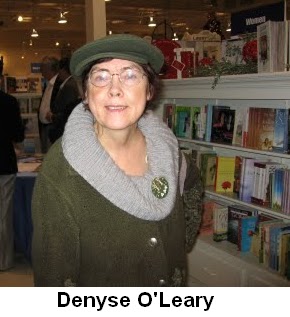
Denyse O'Leary wasn't impressed [The Latest From Lenski’s Lab]. She doesn't know very much about science so she has to rely on the opinions of other IDiots. In this case, she relies on Ann Gauger who published a comment on the website of The Biologic Institute [Inovation or Rennovation].

Read more »

Lenski's long-term evolution experiment: the evolution of bacteria that can use citrate as a carbon source

Richard Lenski set up twelve flasks of E. coli B back in 1988. They were allowed to grow overnight in minimal medium containing 139μM glucose and 1,700 μM citrate. The glucose was the only carbon source that the parent strain could use and it limited growth of the cultures. The citrate was present as a standard chelating agent. The bacteria could not take up citrate and use it as an additional carbon source.

Every day the culture was diluted by transferring one ml to 99 ml of fresh medium (1/100). There were 6.64 generations per day or 2,423 generations per year (slightly more in a leap year).

These cultures were under strong selective pressure. Individual bacteria that could grow faster would out-compete other bacteria in the culture and take over. Lenski expected that each culture would show a variety of different solutions to the selective pressure with many common mutations and many that could be unusual.

Read more »

Anna Ewers, Ophelie Guillermand - Vogue Italia - December 2013

Photography: Steven Meisel
Stylist: Marie-Amelie Sauve
Hair: Guido
Makeup: Pat McGrath